
A compassionate guide for families in Alameda, Berkeley, Oakland, and across the East Bay
There’s a moment many families in Alameda County quietly recognize—though few talk about it openly.
It’s 2 a.m., and you’re lying awake replaying the day: the gas burner left on, the missed medication, the look of confusion on your mother’s face when she didn’t recognize you. You love this person with everything you have. And that love is exactly why you’re finally asking the question you’ve been afraid to voice:
Is it time to get professional Alzheimer’s care at home?
If you’re here, you already sense the answer. This guide is written to help you trust what you’re feeling—and to walk you clearly and compassionately through what your next steps can look like.
What Does “Alzheimer’s Care at Home” Actually Mean?
Alzheimer’s care at home—sometimes called in-home memory care—means bringing trained, compassionate caregivers into your loved one’s own living space to support their daily life, safety, and dignity.
This is meaningfully different from moving to a memory care facility. With in-home care, your loved one stays in the environment they know: their own bedroom, their familiar kitchen, their garden. That continuity matters profoundly for people living with Alzheimer’s disease, who often find comfort in familiar surroundings even as memory fades.
What Professional In-Home Alzheimer’s Care Typically Includes:
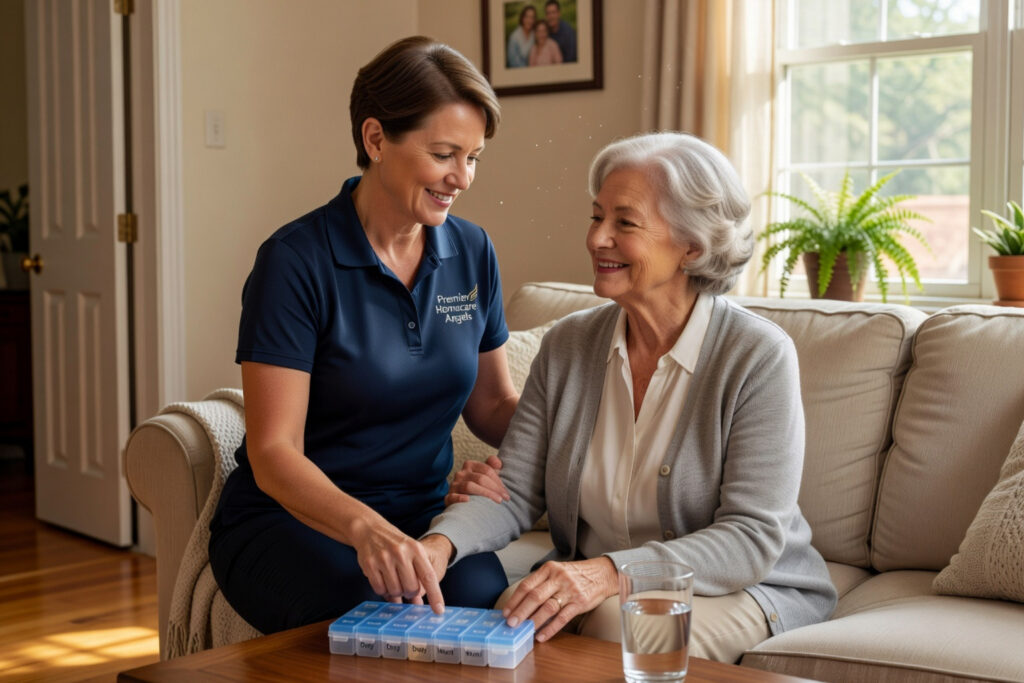
- Medication reminders and daily health monitoring.
- Structured daily routines that reduce anxiety and confusion.
- Safe mobility assistance including bathing, dressing, and moving around the home.
- Engaging companionship and gentle cognitive activities.
- Nutritious meal preparation tailored to specific dietary needs.
- Supervision during high-risk hours, including late afternoon and evening.
- Caregiver respite to give you and your family vital time to rest and recover.

The Signs It’s Time for In-Home Alzheimer’s Care
In our years of coordinating care for families across the East Bay, one pattern repeats itself: families wait longer than they should—often out of love, guilt, or quiet exhaustion. Knowing the signs clearly, without softening them, can make all the difference.
Signs in Your Loved One
Consider professional Alzheimer’s care at home if your loved one is:
- Getting lost in familiar places—even within their own neighborhood or home.
- Leaving the stove on, forgetting meals, or not drinking enough water.
- Unable to recognize close family members or longtime friends.
- Becoming agitated, confused, or restless in the late afternoon or evening—a common pattern known as sundowning.
- Showing signs of depression, social withdrawal, or increasing fearfulness.
- Falling, or nearly falling, more frequently than before.
- Needing hands-on help with bathing, dressing, or using the restroom.
- Wandering outside, especially at night or in unfamiliar conditions.
⚠️ Take Note: Any one of these signs is worth a serious conversation. Multiple signs together suggest the window for safe, family-only caregiving may be closing.
Signs in You, the Caregiver
Alzheimer’s care is never just about the person with the diagnosis. It’s about the whole family. Reach out for support if you are:
- Skipping your own doctor appointments, meals, or sleep to manage care.
- Feeling resentment, helplessness, or emotional numbness more than relief.
- Missing work, losing income, or neglecting your own health.
- Afraid to leave your loved one alone, even for an hour.
- Carrying the full weight of care largely on your own, without meaningful backup.
Caregiver burnout is real—and across Oakland, Berkeley, Alameda, and the broader East Bay, it affects thousands of families quietly and invisibly. Your wellbeing is not separate from your loved one’s care. It is inseparable from it.
📋 “Is It Time?” — A Practical 10-Sign Checklist
Print this. Check it honestly. Share it with your siblings or your spouse to take an objective look at where things stand right now.
- Frequent Falls: My loved one has had at least one fall or near-fall in the past three months.
- Medication Mishaps: They can no longer manage their medications safely on their own.
- Household Hazards: They have left the stove on or forgotten meals on more than one occasion.
- Caregiver Exhaustion: I am sleeping poorly or living in a constant state of high alert.
- Declining Hygiene: Personal hygiene has noticeably declined, and they resist help from family.
- Disorientation: They have wandered outside or become disoriented in familiar surroundings.
- Isolated Grieving: I feel I am losing the person I knew—and I am grieving largely alone.
- Behavioral Changes: They are increasingly agitated, fearful, or showing paranoid thinking.
- No Backup Support: Other family members are unable or unavailable to share caregiving responsibilities.
- Professional Advice: A physician, social worker, or geriatric care manager has suggested it may be time for additional support.
✦ If you checked 3 or more items—or even just one of the critical safety risks like wandering or medication errors—it is time for a professional care assessment. This is not a failure. It is one of the most loving decisions a family can make.
Why East Bay Families Often Wait—and What That Delay Can Cost
Families in Oakland, Berkeley, and Alameda tend to be resourceful, deeply independent, and fiercely devoted to the people they love. Those same qualities can make it harder to ask for help.
We hear this often: “I promised I’d never put her in a home.” Or: “He’d be devastated if strangers came in.” Or simply: “We’re managing. I think.”
Here is the compassionate truth: in-home care is not about giving up. It is about expanding the circle of care around someone you love. A well-matched, professionally trained caregiver often becomes a genuinely trusted presence—someone your loved one looks forward to seeing each day.
Waiting too long, on the other hand, can lead to:
- A preventable fall or injury that results in an emergency room visit.
- A care crisis that forces rushed, overwhelming decisions under heavy pressure.
- Faster cognitive decline due to social isolation, poor nutrition, or a disrupted routine.
- Serious physical and emotional health deterioration for the family caregiver.
What In-Home Alzheimer’s Care Looks Like, Day to Day
Every care plan is shaped around the individual person—their history, their rhythms, and their preferences. But here’s a picture of what thoughtful Alzheimer’s care at home might look like in a typical East Bay household:
- Morning: A caregiver arrives to support a gentle wake-up routine, personal hygiene, and a nourishing breakfast. Medications are given on schedule. Familiar music plays softly in the background.
- Midday: Light, purposeful activity—perhaps a short walk through Alameda’s flat, tree-lined streets, a simple puzzle, or an unhurried conversation over lunch. A rest period follows naturally.
- Afternoon: Engagement activities built around your loved one’s life story and interests. A former East Bay teacher might enjoy reading aloud; a retired gardener might tend a small pot of herbs on the sunny patio.
- Evening: If care extends later in the day, the caregiver helps with dinner, a calming wind-down routine, and safe settling into bed—which is especially important for families navigating difficult sundowning behaviors.
The routine itself is therapeutic. Predictability reduces anxiety in people living with Alzheimer’s, and a consistent caregiver relationship builds genuine trust over time.

What California Families Should Know Before Hiring In-Home Care
If you’re exploring Alzheimer’s care at home in Alameda, Berkeley, Oakland, or surrounding East Bay communities, choosing a properly licensed agency is essential.
In California, non-medical in-home care agencies are regulated by the California Department of Social Services (CDSS) under the Home Care Services Consumer Protection Act. Compliant agencies are legally required to:
- Register all caregivers as Home Care Aides (HCAs) with the state.
- Conduct thorough background checks through the California Department of Justice.
- Provide ongoing training and supervision for all care staff.
- Maintain appropriate liability insurance and bonding.
When you work with a CDSS-compliant agency, you have real, enforceable protections for your family. Always ask any agency you interview to confirm their state license number and verify their Home Care Aide Registry compliance before care begins.
💰 On Cost: In-home care in the Alameda and Oakland areas typically ranges from $40 to $55+ per hour, depending on the complexity of care and hours needed. For families managing costs, it is worth exploring whether a long-term care insurance policy is in place, or whether your loved one may qualify for California’s Medi-Cal Home and Community-Based Services (HCBS) programs.
How to Start the Conversation With Your Loved One
For many families, this is the hardest part. A few approaches that tend to open the door gently:
- Frame it around companionship, not care. Saying, “I’d love for you to have someone to spend time with and help around the house” lands very differently than “You need help.”
- Involve them in the decision. As much as their cognitive capacity allows, ask what matters most to them and genuinely honor those micro-preferences.
- Start small. Begin with just a few hours, two or three days a week. Let trust and familiarity build at its own natural pace.
- Expect some initial resistance. Don’t let a defensive reaction be the final word. Resistance often softens beautifully once they meet the right person, in their own space, on their own terms.
If the conversation feels impossible to navigate alone, a professional care advisor or hospital social worker can help facilitate it. Many families find it easier when the guidance comes from a neutral, knowledgeable voice.
You’ve Already Done So Much. Let Us Help You With What Comes Next.
If you’re a family in Alameda, Berkeley, Oakland, Piedmont, San Leandro, or anywhere across the East Bay who has been quietly carrying this weight—we see you.
Our local care team specializes in Alzheimer’s and dementia in-home support. We are licensed, CDSS-compliant, and deeply rooted in this community. We understand the unique needs of East Bay families, and we are here to help you find a path forward that feels safe, dignified, and right.